Hard Hats and High Standards: Arab-American Women Who Are Building More Than Just Structures
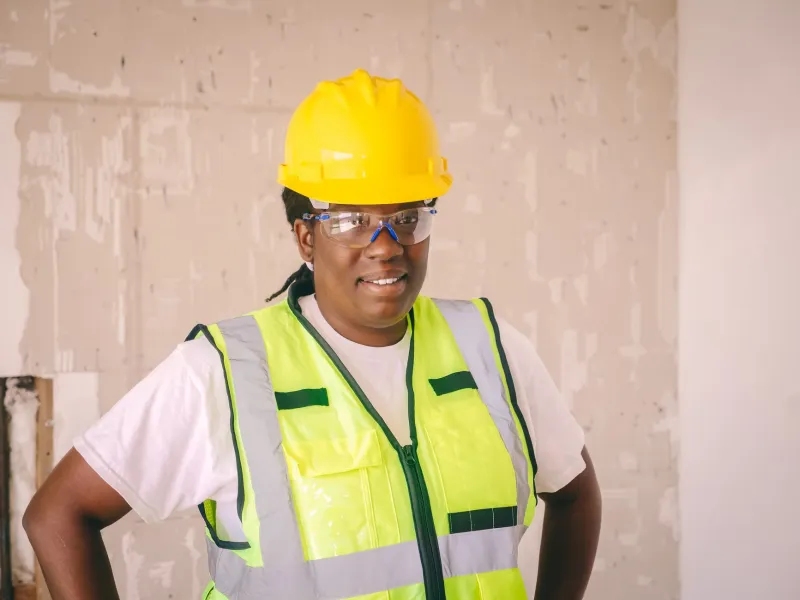
When Nadia Khalil walked onto her first construction site in suburban Detroit at 22, she got two reactions: silence and stares. Some guys looked at her like she'd walked into the wrong movie. A few were openly rude. One foreman asked her — twice — if she was there to drop off lunch.
She wasn't. She was there to learn electrical work, and eventually, to run it.
Today, Nadia is a licensed electrical contractor with her own small crew, a client list that keeps growing, and a reputation in her community that surprises people who still picture the trades as a man's world — or worse, assume Arab-American women aren't interested in getting their hands dirty.
"People in my own family thought I was going through a phase," she laughs. "My teta still asks me when I'm going to get a 'real job.' I own a business, teta. This is as real as it gets."
The Numbers Tell a Story (Even If the Industry Doesn't Want to)
Women make up only about 11% of the construction workforce in the U.S., according to the Bureau of Labor Statistics — and within that number, Arab-American women are even harder to count. There's no clean federal data that tracks this particular demographic intersection, which is itself part of the problem. When you're invisible in the statistics, it's easier to stay invisible in the room.
But talk to workforce development organizations in cities like Dearborn, Michigan — home to one of the largest Arab-American communities in the country — and a different picture starts to emerge. Programs like the ACCESS workforce training initiatives and local trade apprenticeships have seen a steady uptick in Arab-American women enrolling in skilled trades programs over the past five years. It's not a flood. But it's a current that's picking up speed.
"We're here," says Samira Azar, a civil engineer turned construction project manager based in Houston. "We've always been here. We're just getting louder about it."
When Culture and Career Collide
For many Arab-American women in the trades, the workplace isn't the only arena where they're fighting for legitimacy. The dinner table can be just as complicated.
Family expectations — particularly in more traditional households — often center on education paths that lead to medicine, law, or education. The trades, by contrast, can carry a kind of dual stigma: they're seen as physically demanding in ways that feel "inappropriate" for women, and simultaneously undervalued compared to white-collar careers. That's a narrow corridor to navigate.
Leila Mansour, a plumbing apprentice in the Chicago metro area, knows this tension well. Her parents immigrated from Lebanon in the 1990s and built their lives around the idea that their kids would go to college and get professional jobs. When Leila chose a union apprenticeship over a four-year degree, it created friction.
"My dad didn't speak to me for two weeks," she says, no longer bitter about it. "Then he saw my first paycheck stub. Then he saw me fix a busted pipe at my uncle's house on Thanksgiving. Now he brags about me at the mosque."
That shift — from skepticism to pride — is a pattern that repeats itself across communities. Success, it turns out, is a pretty effective argument.
Discrimination Doesn't Clock Out
It would be dishonest to tell these stories without naming what many of these women face on the job. Sexism in the trades is well-documented, and for Arab-American women — who may wear hijab, have visibly Arabic names, or navigate assumptions about their religion and culture — the layers compound.
Nadia recalls a client who, after seeing her name on an invoice, asked her supervisor if she was "allowed to work in America." Samira has had colleagues question her technical decisions in ways she's convinced they wouldn't question a white male peer with half her credentials. Leila has learned to document everything.
"You develop armor," Samira says. "Not because you want to be hard. But because you have to protect yourself while also proving yourself, and that's exhausting. You do it anyway."
Organizations like the National Association of Women in Construction (NAWIC) and various union diversity programs are working to address these issues systemically, but the women we spoke to were clear: structural change is slow, and in the meantime, you build your own support networks.
Community as a Tool Belt
One of the most striking things about Arab-American women in the trades is how deliberately they're building community with each other — and paying it forward.
Nadia mentors two younger women from her neighborhood who are exploring electrician apprenticeships. Samira speaks at local high schools, specifically targeting Arab-American girls who've never considered construction as a career path. Leila has connected with a small but growing group of Arab and Muslim women in trades across the Midwest through social media, turning a scattered handful of individuals into something that feels more like a movement.
"We find each other," Leila says. "And when we do, there's this moment of — oh, I'm not crazy. This is possible. Someone else is doing it."
That visibility matters enormously. Research consistently shows that girls are more likely to pursue careers where they can see people who look like them succeeding. For Arab-American girls, representation in trades has historically been near zero. Every woman who shows up on a job site — especially visibly, proudly — changes that math a little.
What They're Actually Building
Here's the thing about the trades: they pay. A licensed electrician in the U.S. earns a median wage of over $60,000 annually, with experienced contractors pulling in significantly more. Plumbers, HVAC technicians, project managers — the numbers are competitive, often exceeding what many four-year-degree paths deliver, especially when you factor in the debt those degrees carry.
For Arab-American women who are thinking about economic independence, generational wealth, and building something tangible — both literally and figuratively — the trades make a lot of sense.
"I own my business. I set my hours. I hire people who work hard," Nadia says. "I built this. Nobody handed it to me."
There's a quiet poetry in that — an Arab-American woman, daughter of immigrants, using her hands to construct not just buildings, but a life that looks exactly the way she designed it.
Al Farra has always believed that community is built, not just inherited. And these women? They're out here with the blueprints, the tools, and the will to prove it.
Know an Arab-American woman in the trades or a skilled industry making waves? We want to hear about her. Reach out to us at elfarra.org.