More Than a Latte: Inside the Arab-American Spaces Where Coffee Comes With Community Built In
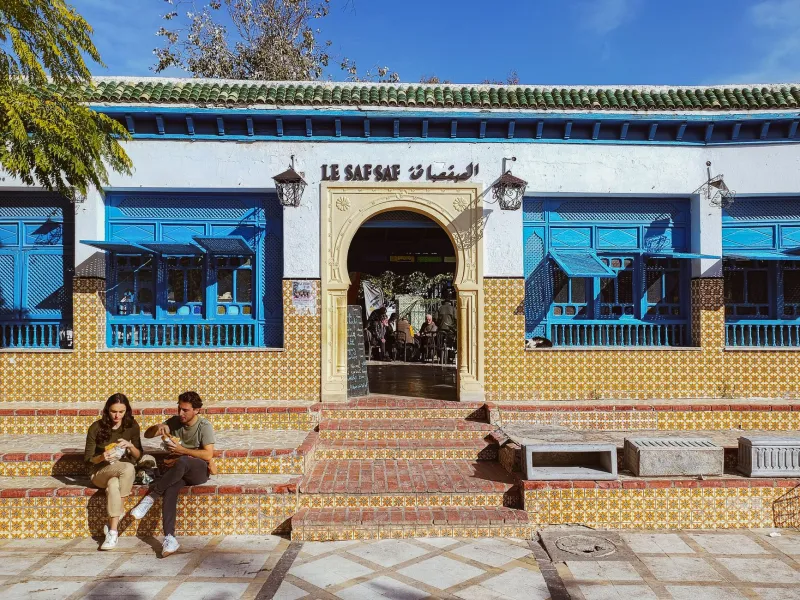
Walk into Marhaba Lounge on a Thursday evening in Dearborn, Michigan, and you'll find a scene that's hard to categorize. A pair of cousins are huddled over a laptop in the corner, workshopping a business pitch. A group of hijabi women in their twenties are laughing over a shared plate of knafeh and iced mint tea. Near the front, a guy with a sketchbook is deep in conversation with someone who just handed him a business card. The hookah coals are glowing, the playlist is bouncing between Fairuz and Frank Ocean, and nobody seems to be in any particular hurry to leave.
This is the third space — not home, not work, but somewhere in between. And for a growing number of Arab-Americans across the country, it's becoming one of the most important places in their lives.
What's a Third Space, and Why Does It Matter?
Urban sociologists have talked about third spaces for decades — the idea that healthy communities need somewhere beyond the home and the office where people can gather without a specific agenda. Historically, for Arab and Arab-American communities, that role was filled by the diwan or diwaniyya: a dedicated sitting room or communal space where neighbors, friends, and family would drop in, share tea, argue about politics, and just exist together.
But as Arab-American families spread across suburbs and cities, those traditional spaces got harder to maintain. The diwan moved into the basement, then disappeared altogether. What's filling that gap now? Increasingly, it's a new wave of Arab-American-owned cafés, hookah lounges, and cultural gathering spots — places that feel like a modern reinterpretation of something ancient.
"We weren't trying to open a coffee shop," says Rami Haddad, co-owner of Saha Café in Houston, Texas. "We were trying to open a place. There's a difference. A coffee shop sells you a drink and moves you along. We want you to stay. We want you to meet someone. We want you to feel like you belong somewhere."
Saha — the Arabic word for health or cheers — opened in 2021 and has since become a fixture in Houston's growing Arab-American community. On any given weekend, you might find a pop-up market for local Arab-American vendors, an open mic night where performers switch between English and Arabic mid-verse, or just a packed room of regulars who've been coming every Friday for two years straight.
The Gen Z and Millennial Factor
What's particularly striking about these spaces is who's showing up. Arab-American Gen Z and millennials — many of them second or third generation, navigating dual identities in a post-9/11 world that has never been entirely comfortable with their existence — are gravitating toward these spots with a kind of urgency that feels meaningful.
"I grew up kind of ashamed of being Arab, honestly," says Nadia Khalil, 26, a regular at a cultural lounge in Chicago's Albany Park neighborhood. "Like, I never wanted to bring friends to my family's house because I thought it was weird or different. But coming here? I feel proud. I feel like, this is who I am and it's actually cool."
That sense of reclamation is something owners are very deliberate about. Many of these spaces are decorated with vintage Arabic calligraphy prints, locally made ceramics, and menus that don't apologize for unfamiliar ingredients. The aesthetic isn't trying to make Arabic culture palatable for a mainstream American audience — it's designed for people who already know what arak is, who grew up eating maamoul at Eid, who want a place that reflects them back without explanation.
At the same time, these spaces are remarkably welcoming to outsiders. "We get non-Arab customers all the time, and we love that," says Haddad. "But the difference is, here, we're not the ones adapting. You come to us. You get curious. You ask questions. That's a different dynamic than what you usually see."
Side Hustles, Soft Launches, and Social Capital
Beyond the cultural dimension, these cafés and lounges are quietly functioning as informal economic incubators. Because they attract a critical mass of Arab-American young professionals, creatives, and entrepreneurs, they've become natural networking hubs — the kind of place where a graphic designer meets a restaurant owner, or a marketing consultant gets their first client over a round of tea.
Layla Mansour, 30, launched her modest fashion brand after connecting with her now-business-partner at a hookah lounge in Anaheim, California. "We literally met because we were both sitting alone at the bar area and the owner introduced us," she says, laughing. "He said, 'You're both doing something with fashion, you should talk.' That was two years ago. Now we have a real business."
Several lounge owners have started formalizing this dynamic by hosting dedicated networking nights, entrepreneurship workshops, or vendor markets specifically for Arab-American small business owners. It's a recognition that the social infrastructure these spaces provide has real economic value — and that the community is hungry for it.
"In mainstream networking events, you spend half your energy explaining your background," says Mansour. "Here, you just skip all of that. You get to the actual conversation faster."
Not Without Its Complications
Of course, building a community space is never simple. Several owners Al Farra spoke with mentioned the challenge of managing the tension between being a business and being a community resource. When rent is due, you need paying customers — but when a group of college students nurses one mint lemonade for three hours while they study, do you rush them out?
"That's the hardest part," admits Sara Yousef, who runs a cultural café in the Washington D.C. metro area. "We want to be that open space where people can just be. But we're also a small business trying to survive. You have to find the balance."
Some owners have gotten creative — introducing membership models, ticketed event nights, or community sponsorships from local Arab-American organizations to supplement revenue without compromising the open-door feel.
There's also the question of who gets to define the space. Arab-American communities are not monolithic — they span Lebanese, Palestinian, Egyptian, Yemeni, Syrian, Iraqi, and dozens of other backgrounds, each with distinct cultural traditions and sometimes real tensions. Building a space that feels genuinely inclusive across that spectrum requires ongoing intentionality.
"We always say, every Arab is welcome here, but no one gets to claim the space as exclusively theirs," says Haddad. "That's a conversation we have to keep having."
The Bigger Picture
What's happening in these cafés and lounges is part of a broader cultural moment. Arab-Americans — long rendered invisible in mainstream American culture, or flattened into stereotypes — are asserting their presence in ways that are joyful, intentional, and increasingly visible. And the places they're choosing to gather are becoming the physical manifestation of that assertion.
The diwan never really disappeared. It just moved, adapted, and found a new address — somewhere between a cappuccino machine and a hookah pipe, between a playlist that speaks two languages and a room full of people who finally feel like they're exactly where they're supposed to be.