Pass the Hummus, Hold the Judgment: How Arab-American Gen Z Is Changing What Gets Said at the Dinner Table
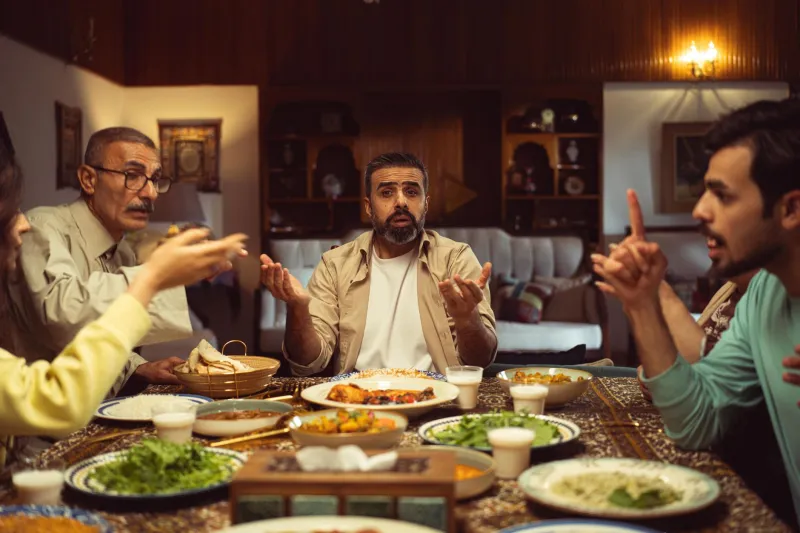
There's a particular kind of quiet that falls over a Lebanese household when someone says something unexpected at dinner. You know the one. The kind where your teta pauses mid-bite, your uncle suddenly becomes very interested in his plate of kibbeh, and your mom gives you the look — the one that says, we'll talk about this later.
For Nadia, a 22-year-old Palestinian-American college student in Dearborn, Michigan, that quiet used to terrify her. Now, she kind of leans into it.
"I brought up that I was thinking about switching my major from pre-med to graphic design," she laughs. "You would've thought I announced I was moving to Mars. But we talked about it — actually talked — and by the end of the night, my dad was asking to see my portfolio."
That shift — from silence to conversation, from inherited expectation to negotiated understanding — is playing out at dinner tables across Arab-American households nationwide. And Gen Z is leading the charge.
The Table as a Cultural Battlefield (and Also Where the Good Food Is)
The Arab family meal has always been more than just food. It's ceremony. It's connection. It's the place where identity gets passed down with every dish. But for second and third-generation Arab-Americans, that same table can feel like a place where you have to choose between who your family wants you to be and who you actually are.
Yasmine, 24, a Syrian-American from Houston, describes it as "loving two versions of yourself at the same time." Her parents immigrated from Damascus in the late 1990s, and dinner at her house still feels like a small piece of the old country — Arabic floating between bites, her mom's mujaddara on the stove, her dad's oud playlist in the background. But the conversations have changed.
"We talk about things my parents never would've brought up at the table growing up," she says. "Mental health. My relationship. What's happening in Gaza. My sister came out to our parents at dinner, actually. It wasn't perfect, but it happened. That felt like something."
That willingness to push into uncomfortable territory — while still showing up, still breaking bread, still staying — is what defines this generation's approach. They're not walking away from the table. They're just refusing to leave parts of themselves outside the door.
Honest Conversations Without Blowing Up the Family Group Chat
It's not always smooth, and nobody's pretending it is. Navigating progressive values inside traditional family structures is genuinely hard work, and Gen Z Arab-Americans are figuring it out in real time.
Karim, 21, an Egyptian-American from New Jersey, says he's learned to pick his moments. "I'm not going to bring up something heavy when my dad just got home from a twelve-hour shift," he explains. "But I also stopped pretending I agree with things I don't. That was making me feel invisible."
For him, the turning point came when he started asking his parents questions instead of making declarations. "My dad would say something about religion and instead of shutting down or arguing, I'd ask him why he felt that way. And then he'd actually tell me. And then I'd tell him where I was at. It's slower, but it works better."
This approach — curious rather than combative — shows up again and again in conversations with young Arab-Americans. It's less about winning an argument and more about staying in relationship while being honest. Which, honestly, is harder.
New Traditions Growing Out of Old Ones
What's emerging isn't a rejection of Arab culture — it's more like a remix. These young adults aren't trying to flatten their heritage into something more palatable for their American peers. If anything, they're more interested in it than ever. They're learning Arabic on Duolingo, cooking their grandmothers' recipes on TikTok, and organizing community iftars. But they're also insisting that culture can hold complexity.
Some families are finding creative ways to make space for that complexity. Rania, 23, a Jordanian-American in Chicago, says her family started doing what she calls "no-topic Sundays" — dinners where literally anything is on the table to discuss, no subject off-limits. "It started as kind of a joke, but it became this thing we actually look forward to," she says. "My parents surprise me all the time. My mom had opinions about feminism I never knew about. My dad talked about his own doubts about faith. You don't get that if you never ask."
Other families are finding that shared experiences — watching Arab films together, visiting cultural festivals, even just cooking together — create openings for harder conversations that might never happen otherwise. The food, it turns out, is still doing a lot of the work.
The Weight of Being a Bridge
It would be easy to romanticize all of this, but the reality is that being a cultural bridge is exhausting. Many Gen Z Arab-Americans carry real grief about the things they can't share with their families, the parts of themselves that still feel too risky to bring to the table. Some have lost relationships over these conversations. Others are still waiting for the right moment that never quite comes.
Nadia acknowledges the weight of it. "I don't want to make it sound like everything's figured out. There are still things I don't say. There are still nights where I feel really alone in my own family. But I also think staying silent was making everything worse. At least now we're actually in it together, even when it's messy."
That messiness, that willingness to stay in the discomfort rather than smooth it over — maybe that's the most Arab thing about this whole generation. Because if there's one thing every Arab-American kid knows, it's that you don't leave the table early. You stay. You eat. You talk it out.
And then someone brings out the baklava, and somehow, everything feels a little more survivable.
Have a family dinner story of your own? We'd love to hear it. Drop us a note at elfarra.org.