Once Upon a Healing: How Arab-American Therapists Are Rewriting the Rules of Mental Health Care Through Story
There's a reason Scheherazade survived by telling stories. Night after night, she spun tales so compelling, so layered with meaning, that a king couldn't bear to end them — or her. Whether you read that as a parable about survival, power, or the human need for meaning, one thing is clear: Arab culture has always understood that stories don't just entertain. They heal.
That ancient intuition is now finding its way into therapy offices from Dearborn to Los Angeles, where a new generation of Arab-American mental health professionals is doing something quietly revolutionary. They're combining the clinical rigor of Western psychology with the storytelling traditions that have defined Arab culture for centuries — and the results are turning heads in the broader mental health world.
What Is Narrative Medicine, Exactly?
Narrative medicine isn't a brand-new concept in Western clinical settings. Columbia University has offered a formal program in it since 2000, training healthcare providers to listen more carefully to the stories patients tell about their own suffering. The idea is straightforward: how a person frames their experience — the language they use, the characters they cast, the arc they construct — reveals things that a checklist or diagnostic manual simply can't capture.
But for Arab-American therapists, the application goes deeper than a clinical framework. It's personal. Many of these practitioners grew up in households where storytelling was the primary vehicle for everything — moral guidance, family history, emotional processing, even conflict resolution. Grandmothers didn't say "let's talk about your feelings." They told you a story about your grandfather's village, and somehow you understood exactly what you were supposed to take from it.
That indirect, narrative-driven approach to emotional truth isn't a workaround. For many Arab families, it is the way.
Bridging Two Worlds in the Therapy Room
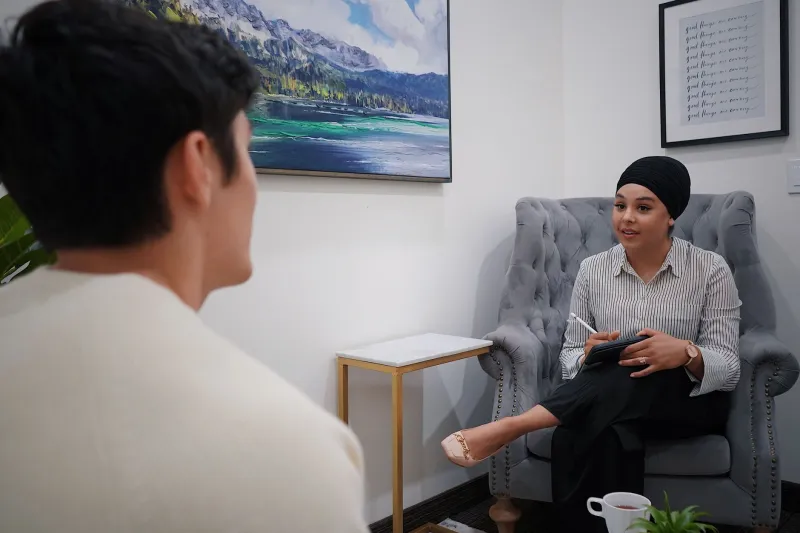
Dr. Lena Khalil, a licensed clinical psychologist based in Chicago who works primarily with Arab-American clients, describes the challenge she faced early in her career as a kind of translation problem — and not just a linguistic one.
"A lot of my clients had been to other therapists before me and felt completely unseen," she says. "They'd be asked to identify their emotions using these very Western, individualistic frameworks, and it just didn't land. Emotions in Arab culture are often communal, relational. You don't feel sad in isolation — you feel sad because of your family, for your family, with your family."
Khalil began incorporating what she calls "narrative mapping" — inviting clients to tell her the stories they grew up hearing, the ones their parents and grandparents told about hardship, resilience, and identity. From there, she helps them trace the emotional threads between those inherited stories and their present-day struggles.
"When someone tells me about their teta's experience leaving Palestine, and then we start talking about their own anxiety about belonging in America, those two things are not separate," she explains. "The story is the bridge."
The Oral Tradition as Therapeutic Tool
In many parts of the Arab world, oral tradition wasn't just entertainment — it was the primary way communities processed collective trauma, preserved identity, and transmitted values across generations. The hakawati, or professional storyteller, was a revered figure in coffeehouses and public squares, weaving tales that reflected the social and emotional life of the community back to itself.
That tradition, therapists argue, carries real clinical weight. Research in trauma-informed care has increasingly supported the idea that narrative reconstruction — helping patients build coherent stories out of fragmented traumatic memories — is one of the most effective tools available for treating PTSD, grief, and identity-based distress.
For Arab-Americans navigating the particular pressures of immigrant identity, generational displacement, and post-9/11 cultural scrutiny, that kind of narrative coherence can be transformative.
Amir Haddad, a therapist in Dearborn, Michigan — home to one of the largest Arab-American communities in the country — works extensively with second-generation clients who describe feeling caught between two worlds. "They're told one story at home and a completely different story by the culture they're living in," he says. "Part of the work is helping them author their own story. Not their parents' story, not America's story about Arabs. Their story."
When Stigma Meets Story
Mental health stigma remains a significant barrier in many Arab and Muslim communities. Seeking therapy can be seen as a sign of weakness, a family embarrassment, or even a spiritual failing. These aren't monolithic attitudes — Arab-American communities are extraordinarily diverse — but they're real enough to keep a lot of people from getting help.
Narrative-based approaches, several practitioners note, can actually help lower that barrier. When therapy is framed not as "fixing what's broken" but as "understanding your story," it becomes less threatening. It aligns more naturally with cultural values around wisdom, reflection, and communal meaning-making.
"I had a client who refused to call what we were doing 'therapy' for the first six months," Haddad recalls with a laugh. "He called it 'talking about things.' Fine by me. We were doing the same work."
For some practitioners, incorporating traditional storytelling forms — the structure of a maqama, the rhythm of a folk tale, even the call-and-response patterns of oral poetry — creates a kind of cultural familiarity that makes the therapeutic space feel less foreign and more like home.
A Growing Movement
Across the US, Arab-American mental health organizations are beginning to formalize some of these approaches. Groups like the Arab American Family Services in suburban Chicago and the Mental Health Alliance for Arab Communities are developing culturally adapted therapeutic models that explicitly incorporate narrative and oral tradition frameworks.
There's also growing academic interest. A handful of researchers at universities with large Arab-American populations are beginning to study the efficacy of culturally adapted narrative therapies with this demographic — work that could eventually influence clinical training standards nationwide.
For the therapists on the ground, though, the proof is less about peer-reviewed studies and more about what they see in the room. Clients who've spent years in traditional therapy suddenly making breakthroughs. Second-generation young adults finding language for experiences they'd never been able to articulate. Older immigrants, for the first time, being asked to share their stories — not just their symptoms.
"There's something that happens when someone realizes their story matters," Khalil says. "Not just their diagnosis, not just their trauma — their story. That's when real healing starts."
The Bigger Picture
What Arab-American therapists are building isn't a rejection of Western clinical practice. It's an expansion of it — a recognition that effective mental health care has to meet people where they are, culturally and emotionally. And for a community that has been misrepresented, misunderstood, and often rendered invisible in mainstream American culture, having a therapist who not only speaks your language but understands your stories is more than a clinical advantage. It's an act of recognition.
Scheherazade survived because her stories were worth hearing. Arab-American therapists are making the same bet — that when we create space for the right stories, survival starts to look a lot like flourishing.