Ink and Identity: The Young Arab Women Turning Henna Into a Healing Practice
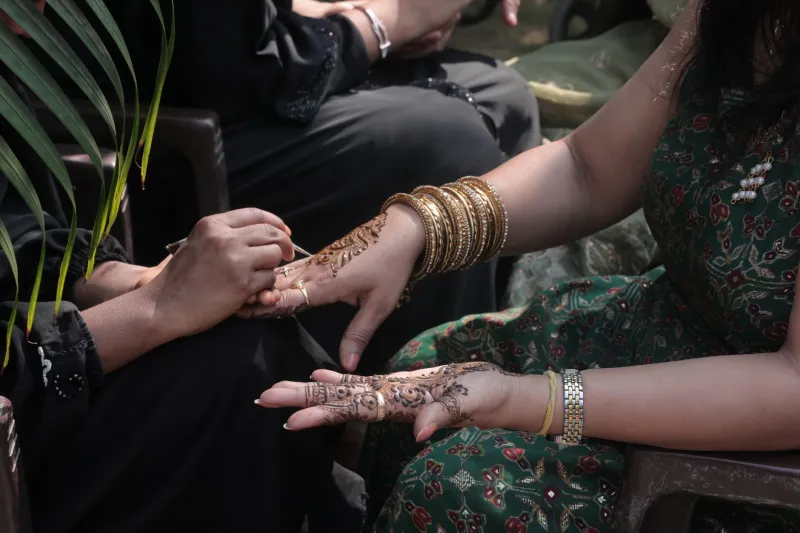
Nadia Yousef remembers the first time she applied henna to her own hands without a celebration attached to it. She was 22, sitting cross-legged on her apartment floor in Brooklyn, and she was having a hard week. "I just needed to feel connected to something," she says. "I put on some Fairuz, mixed the paste, and started drawing. By the time I was done, I felt like myself again."
That quiet, unscripted moment is becoming less rare among young Arab-American women across the country. A practice that has existed for thousands of years — stretching from North Africa through the Arabian Peninsula and into South Asia — is being reclaimed by a generation that grew up caught between cultures, and is now actively choosing to reach back toward their roots. Not because someone told them to, but because it feels good.
More Than a Mehendi Moment
In mainstream American culture, henna has had a complicated visibility. It peaked as a trend in the late '90s — remember the temporary tattoo booths at every mall and music festival? — and for many Arab and South Asian women, watching their sacred tradition become a novelty was disorienting at best and painful at worst.
But Gen Z isn't dwelling on that history so much as actively rewriting it. Across Instagram, TikTok, and Pinterest, young Arab-American women are sharing henna content that looks nothing like the tourist-booth flash sheets of the '90s. These are intricate, intentional designs — sometimes traditional geometric patterns, sometimes bold contemporary motifs, sometimes words in Arabic script — applied with care and shared with context.
Layla Mansour, a 24-year-old henna artist based in Dearborn, Michigan, has built a following of over 80,000 on Instagram by pairing her work with short essays about what each design means to her personally. "I don't just post a photo and say 'DM me to book.' I tell people why I chose this pattern, what it reminds me of, where my grandmother learned it," she says. "People want the story. They want to feel like they're part of something."
Henna as Therapy
Several community organizers and mental health advocates in Arab-American spaces are beginning to recognize what henna artists have known intuitively for years: the practice has genuine therapeutic value.
The act of applying henna — the slow, deliberate drawing, the meditative focus required, the physical sensation of paste on skin — shares qualities with other mindfulness-based practices that are well-documented in mental health research. It requires presence. It demands patience. And it produces something beautiful that you carry on your body for days.
"There's a reason people have used henna in ritual contexts across so many different cultures for so long," says Dr. Sara Haddad, a licensed counselor in the DC area who works extensively with Arab-American clients. "Ritual creates safety. It creates a container for emotion. When my clients tell me they feel calmer after a henna session, I'm not surprised at all."
This intersection of tradition and wellness has inspired a new wave of intentional henna experiences — sessions that are less about booking an artist for an event and more about carving out space for reflection and connection. Mansour recently launched a monthly gathering she calls "Henna & Hadith" — an informal afternoon where women come together to get henna applied, share tea, and talk. No formal agenda, no Instagram-perfect backdrop. Just women, sitting together, being still.
"The first one I hosted, six people showed up," she says. "The last one had forty."
Resistance Written on Skin
For some young Arab-American women, henna carries an explicitly political dimension. In a cultural moment where Arab identity is frequently misrepresented, flattened, or erased in mainstream American media, wearing your heritage visibly on your body is an act of assertion.
Fatima Al-Rashid, a 26-year-old community organizer in Houston, began incorporating henna into her activism work after the 2020 protest season. She and a group of friends started showing up to marches and rallies with henna on their hands — traditional Palestinian patterns, Arabic phrases, olive branches. "People would stop and ask what the designs meant," she says. "It opened conversations that we couldn't have opened any other way. It humanized us in a space where we often felt invisible."
Al-Rashid has since organized a series of "Henna for Healing" pop-up events across Houston, offering free or donation-based henna sessions alongside community resources, mental health check-ins, and cultural education. The events have drawn hundreds of participants, many of whom are not Arab — curious neighbors, fellow activists, and people who simply want to learn.
"Henna is an invitation," Al-Rashid says. "When people ask about your hands, you get to tell them who you are."
The Business of Belonging
The growing demand for culturally intentional henna experiences is also creating real economic opportunity. A new generation of henna artists is building businesses that go far beyond event bookings — offering workshops, product lines, and subscription boxes filled with henna supplies and cultural education materials.
Samar Khalil launched a henna supply company called Rawda Botanicals out of her apartment in Los Angeles in 2022. She sources body-safe, organic henna powder directly from farmers in Morocco and packages it with illustrated guides to traditional patterns and their meanings. The business generated six figures in its first year, almost entirely through word-of-mouth and organic social media.
"I wanted to make it easy for someone who grew up disconnected from the practice to come back to it without feeling like they were doing it wrong," Khalil explains. "There's no wrong way to reconnect with your culture. I just wanted to lower the barrier."
Rawda Botanicals now ships to customers in all 50 states, and Khalil's DMs are full of messages from women — Arab, South Asian, and beyond — telling her that her kits helped them feel closer to grandmothers they never got to know, or traditions they were told to leave behind.
A Practice Without an Expiration Date
What makes this moment feel different from previous cultural reclamation trends is its sustainability. This isn't a viral moment or a seasonal aesthetic — it's a practice with roots deep enough to hold.
Young Arab-American women aren't picking up henna because it's trending. They're picking it up because something in them recognizes it, even if they can't fully articulate why. Because their hands know what their minds are still learning. Because beauty, when it carries meaning, is its own form of resistance.
Nadia Yousef still does her solo henna sessions on hard weeks. She's gotten better at it over the years — her lines are steadier, her patterns more complex. But the reason she reaches for the paste hasn't changed.
"It makes me feel like I belong to something bigger than whatever is stressing me out," she says. "That's worth a lot."